How TimeSense Learns Without Retraining a Model
· 1 min read · 0 views
An AI product does not need to retrain a model after every interaction to become more useful.
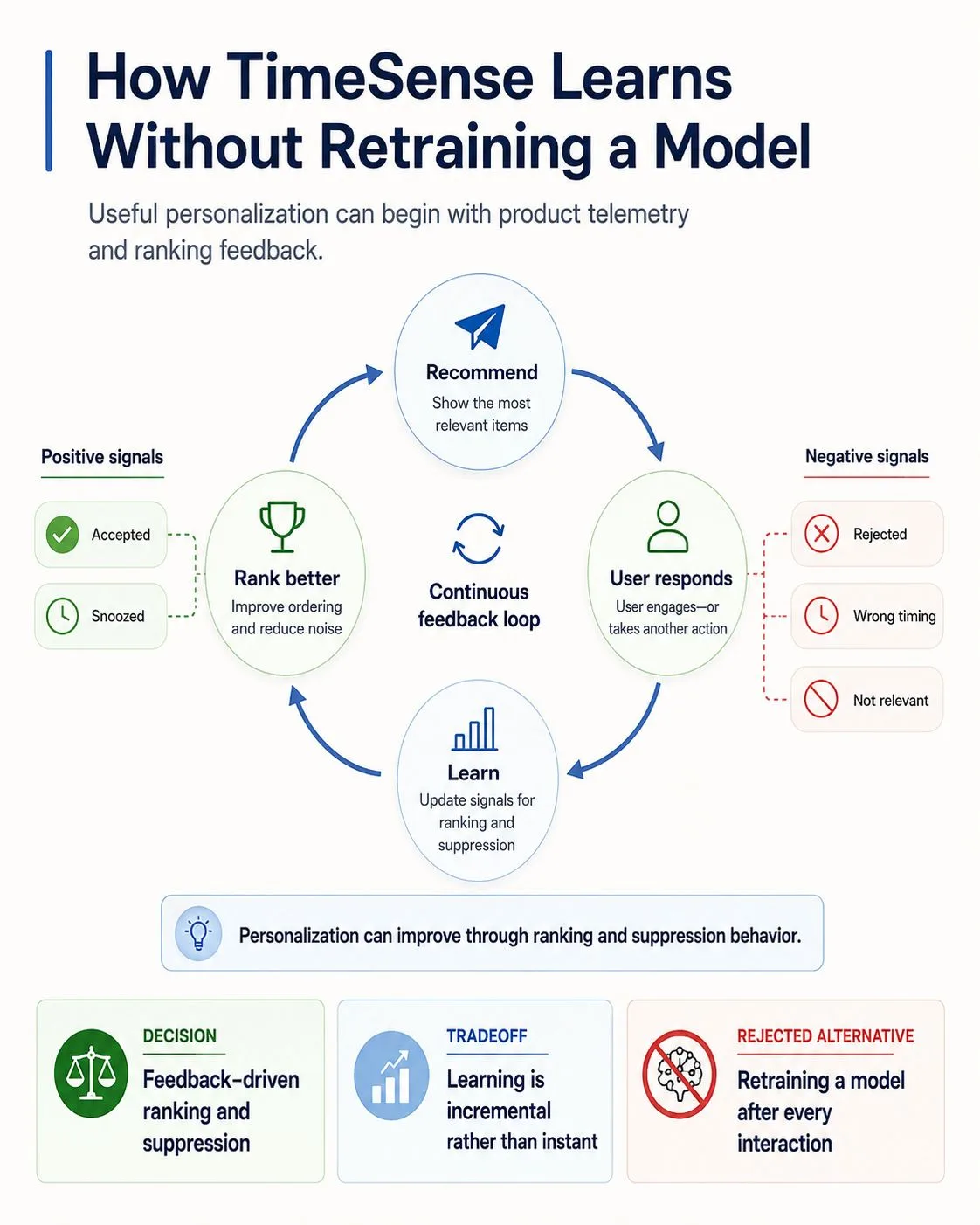
TimeSense records how recommendations perform:
Was the suggestion accepted?
Was it completed, snoozed or rejected?
Was the timing wrong?
Was it not relevant, too large or simply not a priority?
That feedback changes ranking and suppression behavior. A dismissed task is not immediately suggested again, and disagreement reasons can influence how long it is demoted.
This creates a practical learning loop:
Recommend → observe → adjust → recommend better.
The LLM can help interpret context, but personalization also comes from disciplined product telemetry and deterministic behavior.
The tradeoff is that this is not a magical model that instantly “knows” the user. It learns incrementally from explicit and behavioral signals.
The benefit is that the learning process is inspectable, testable and easier to control.
Good AI systems are often built from several kinds of intelligence—not one model doing everything.
Originally posted on LinkedIn.