SCOUT++ Toolkit
2025 · Lead researcher · Active
Toolkit for multimodal HRI experiments and dataset benchmarking of instruction grounding.
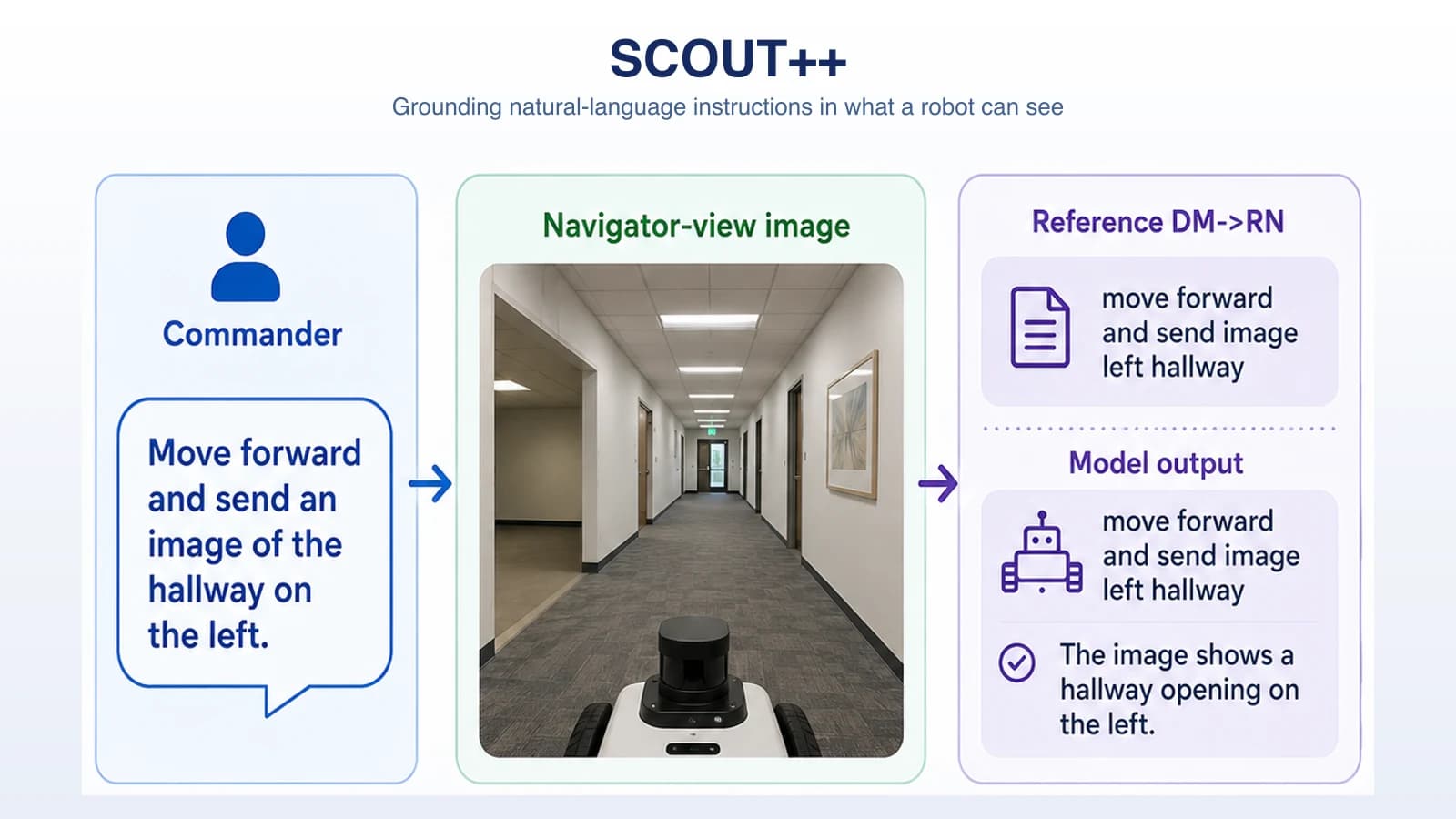
Highlights
- Reconstructed and extended the SCOUT corpus into a standardized set of 11,000+ timestamp-aligned images and 2,474 dialogue pairs.
- Benchmarks three instruction-classification approaches: a neural baseline, GPT-4 text-only, and GPT-4 with synchronized vision.
- Found that the multimodal variant *underperformed* the text-only one, producing vague or hallucinated outputs — a result worth reporting precisely because it cuts against expectations.
- Reproducible pipeline for preprocessing, feature engineering, and experiment orchestration.
Background
SCOUT++ supports research into how well vision-language models actually ground natural-language instructions in what a robot can see.
The headline finding is a negative one. Adding synchronized visual input to GPT-4 *degraded* instruction-classification accuracy relative to text alone, with the multimodal variant more prone to vague or hallucinated outputs. For safety-critical settings like urban disaster response, that is exactly the kind of result that needs publishing rather than tuning away.
Stack
- Python
- PyTorch
- TensorFlow
- OpenCV
- ROS
- GPT-4
Gallery
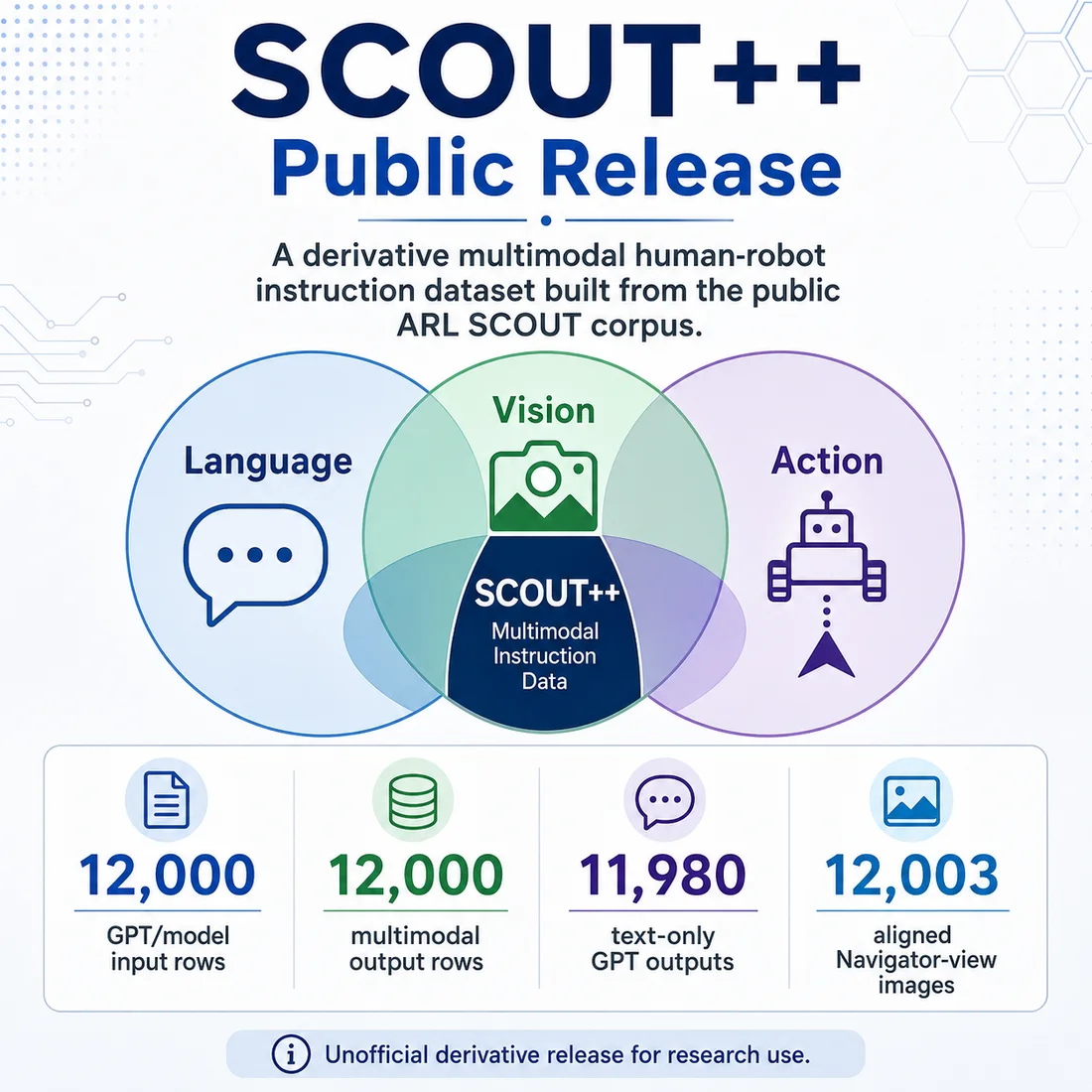
Public release overview — an unofficial derivative of the ARL SCOUT corpus, for research use.
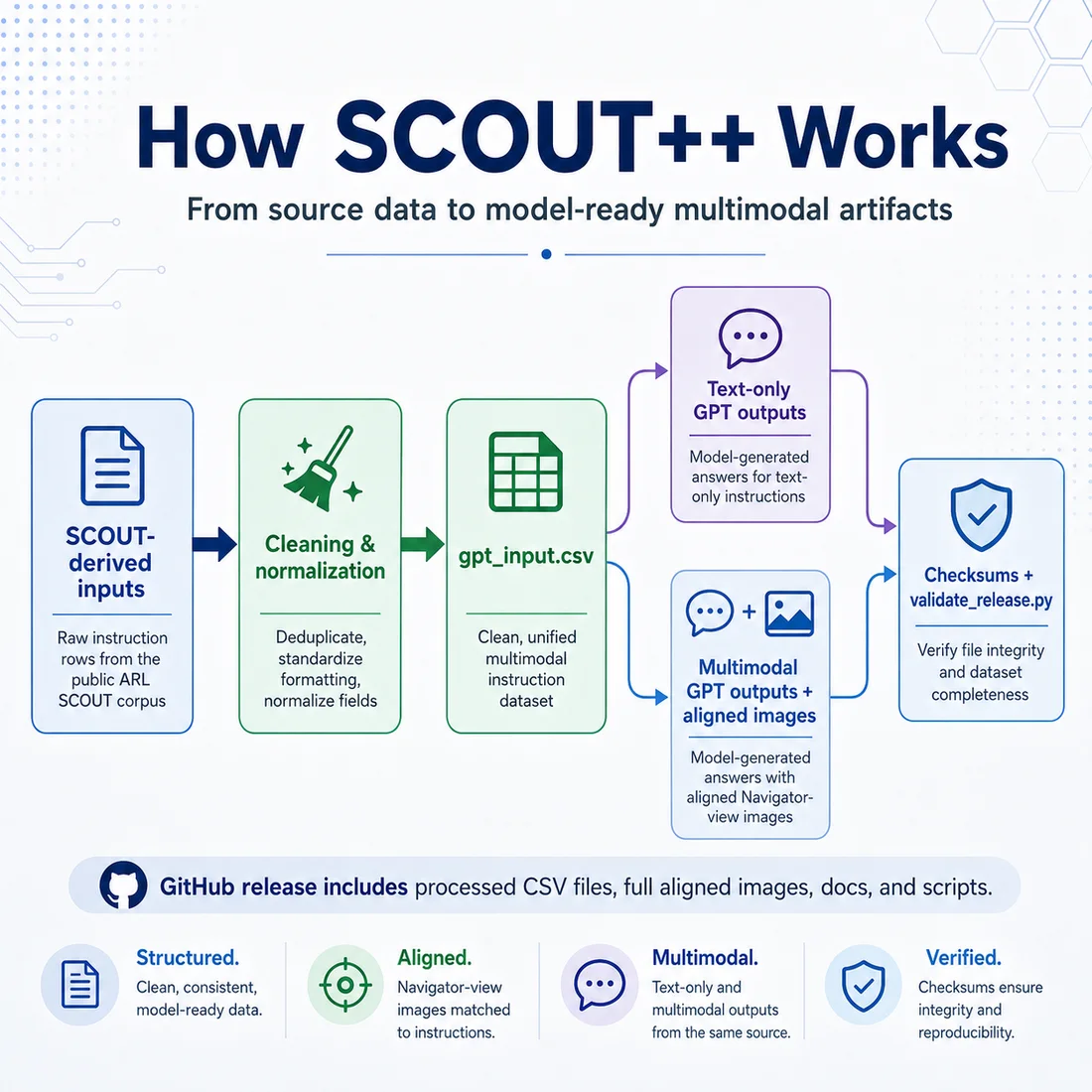
From raw corpus rows to model-ready multimodal artifacts, with checksums for reproducibility.
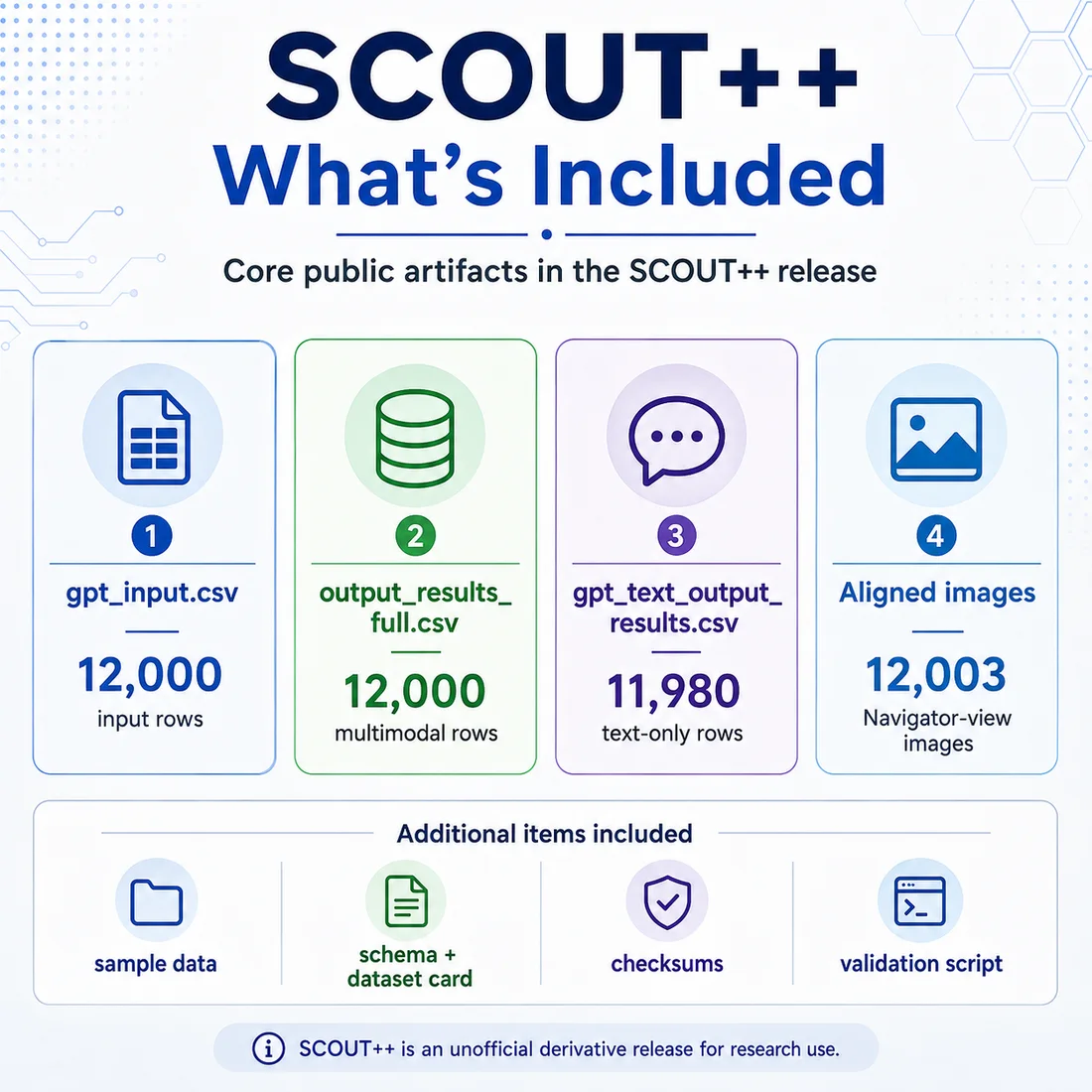
What ships in the public release.