Ask-to-Act Accepted at IEEE RO-MAN 2026
· 1 min read · 0 views
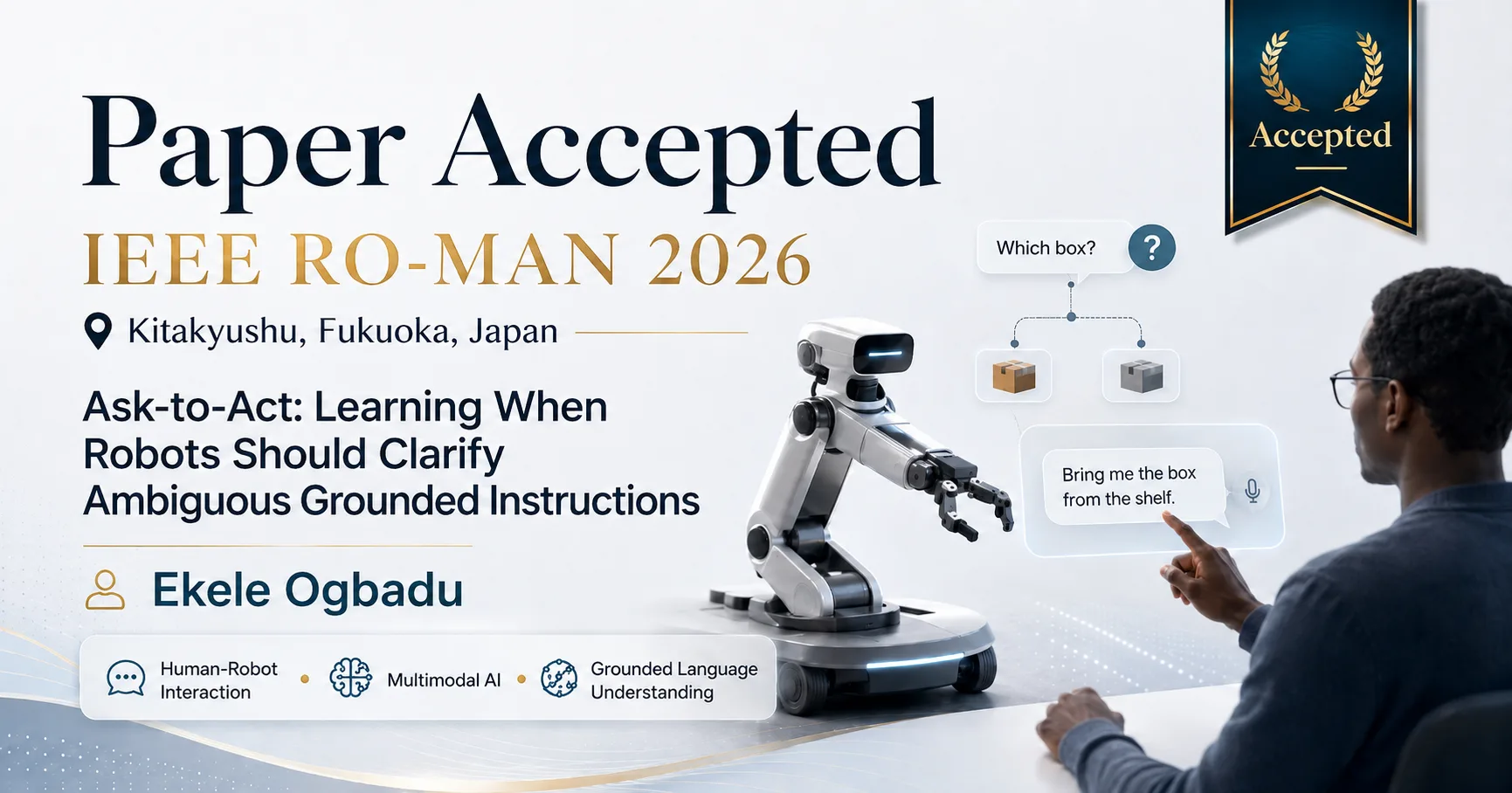
I’m excited to share that my first author paper, “Ask-to-Act: Learning When Robots Should Clarify Ambiguous Grounded Instructions,” has been accepted to IEEE RO-MAN 2026.
This work explores a simple but important question in human-robot interaction:
When should a robot ask a clarification question before acting?
In real-world environments, human instructions are often ambiguous. A command like “move it over there” may be clear to the person giving the instruction, but not to the robot interpreting it. Acting too quickly can lead to errors, while asking too many questions can make the interaction inefficient or frustrating.
Our work studies how robots can learn when clarification is useful and when they already have enough context to act.
This paper is part of my broader research direction around multimodal AI, grounded language understanding, and data-efficient robotics systems. I’m especially interested in how language, visual context, and action-oriented decision-making can help robots better understand human intent in situated environments.
I’m grateful for the guidance, feedback, and support that helped shape this work. Looking forward to presenting it at RO-MAN and continuing to build on this research.
Originally posted on LinkedIn.